
Oostenburg Talk Show #10 – What do you think of Oostenburg-Noord?
Oostenburg Talk Show #10 – a packed Buurtkamer and a clear message
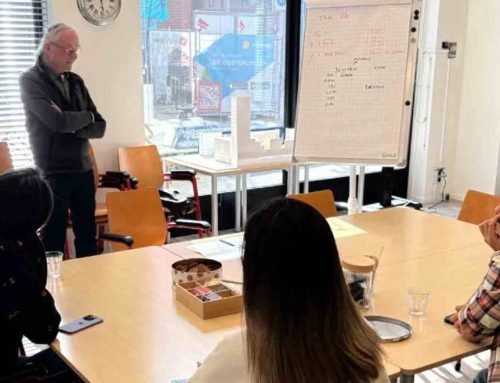
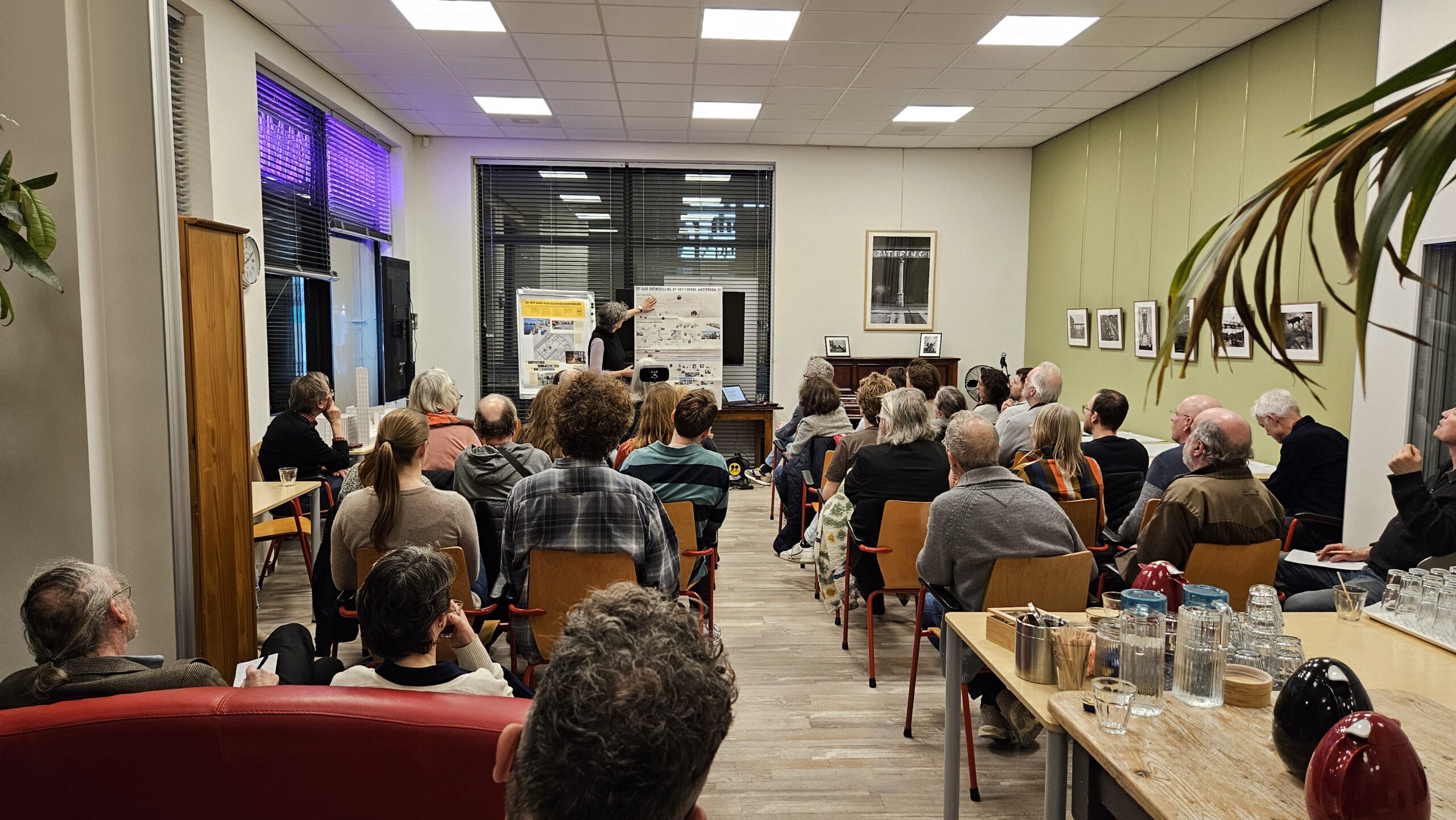
On the evening of Thursday 26 February, the Buurtkamer of the Over de Brug Foundation was packed to the rafters. Even the last standing places were taken. The reason: the results of the second residents’ survey ‘What do you think of Oostenburg-Noord?’ and the question of what will now happen with the survey.
The outcome: potential, but not yet realised
Rob van Dijk, chair of the Over de Brug Foundation, presented a summary of the survey results. The average satisfaction rating for Oostenburg-Noord is 3.2 out of 5. Residents see the neighbourhood’s potential, but feel that it has not yet been realised. The two biggest issues are green spaces (2.1 out of 5) and public spaces (2.2 out of 5). One positive exception: the provision of information, which has clearly improved and scores 3.7 out of 5.
The conclusion was clear: residents are not asking for abstract plans, but for visible, concrete improvements now; temporary ones if necessary.
The professionals have their say
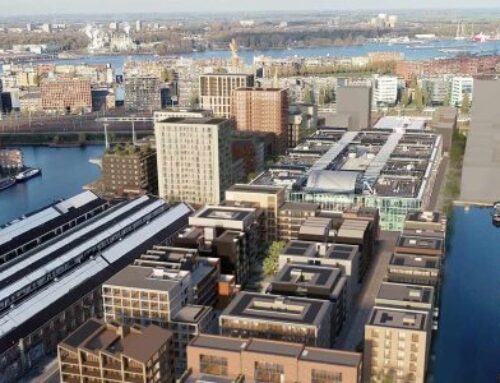
Tess Broekmans of urban planning firm Urhahn, who has been involved in the development of Oostenburg since the outset, presented a graphic overview of twenty years of development on the island. She acknowledged that the living environment had turned out to be too ‘stony’ and that this was already apparent in 2016. Her explanation: plans simply take longer to materialise than the ideas on which they are based. Phased construction inevitably causes disruption, and the renovation of the Van Gendthallen is taking much longer than planned due to unforeseen circumstances. Regarding the slow filling of the ground-floor retail spaces, she noted that it is a well-known fact that the first businesses to set up shop in a new location often do not survive.
Ilse Lek, area supporter for the Oostelijke Eilanden, Dijksgracht and Marineterrein districts for the City of Amsterdam, discussed her responsibilities, including the management of waste containers. Comments and complaints on this subject were immediately raised from the audience. She indicated that she was doing her best to deal with all reports and advised people to use the municipal app. She also announced an inspection during which such complaints would be systematically recorded.
Project developer Rens Nijenhuis of Stadgenoot indicated a willingness to contribute ideas regarding the decking issue. Onno Hoff of Achmea Real Estate expressed his willingness to contribute ideas regarding the design and management of the plinths, partly in relation to safety.
Collective action is needed
Rob van Dijk emphasised that he has seen many issues and problems arise recently, but what strikes him is that there is often a lack of collective action on the part of residents. His appeal: realise that it is in everyone’s shared interest to act collectively.
Board member Aart Nolen referred to a critical article in Het Parool which, in his view, summed up the situation in Oostenburg very accurately, and also mentioned the Manifesto of owners, users and those responsible for Oostenburg, which sets out five ambitions.
Board member Lex Gründeman made a specific appeal to the council and the parties involved: invest in the Buurtplein now, even if it is only temporary. It will be years before the square takes its final form; in the meantime, make it more liveable. That costs money, but we have to be prepared to make that sacrifice for now.
Residents are taking matters into their own hands
Residents also had their say. Neighbour Ronan Connolly spoke about his board game evenings and indicated he was willing to take on more.
Green coach Anneke Pauptit showed what residents can do themselves to make the neighbourhood greener. She highlighted the handy green app from Centrum Oost Groen, which has been used successfully in places such as Wittenburg.
Jarcine Spaander, initiator of several volunteer projects in Oostenburg, shared the success of the greening project at the Zonnewendebrug. The Oploscafé proved an effective method for realising this in collaboration with those involved; one of the successful resident initiatives of the past year.
From words to deeds: the Aanpakkers
Social and Cultural Programme Manager Eddy Appels of Stichting Over de Brug opened the evening by saying that the focus should be on interaction and, ultimately, on taking action. He returned to this in more detail at the end of the evening. Afterwards, attendees could sign up for one of the five Aanpakkers groups: Green, Clean, Social Cohesion, Safety and Plinths. Names were added to each sign-up sheet.
Would you like to get involved too? Sign up, and we’ll get in touch with you.